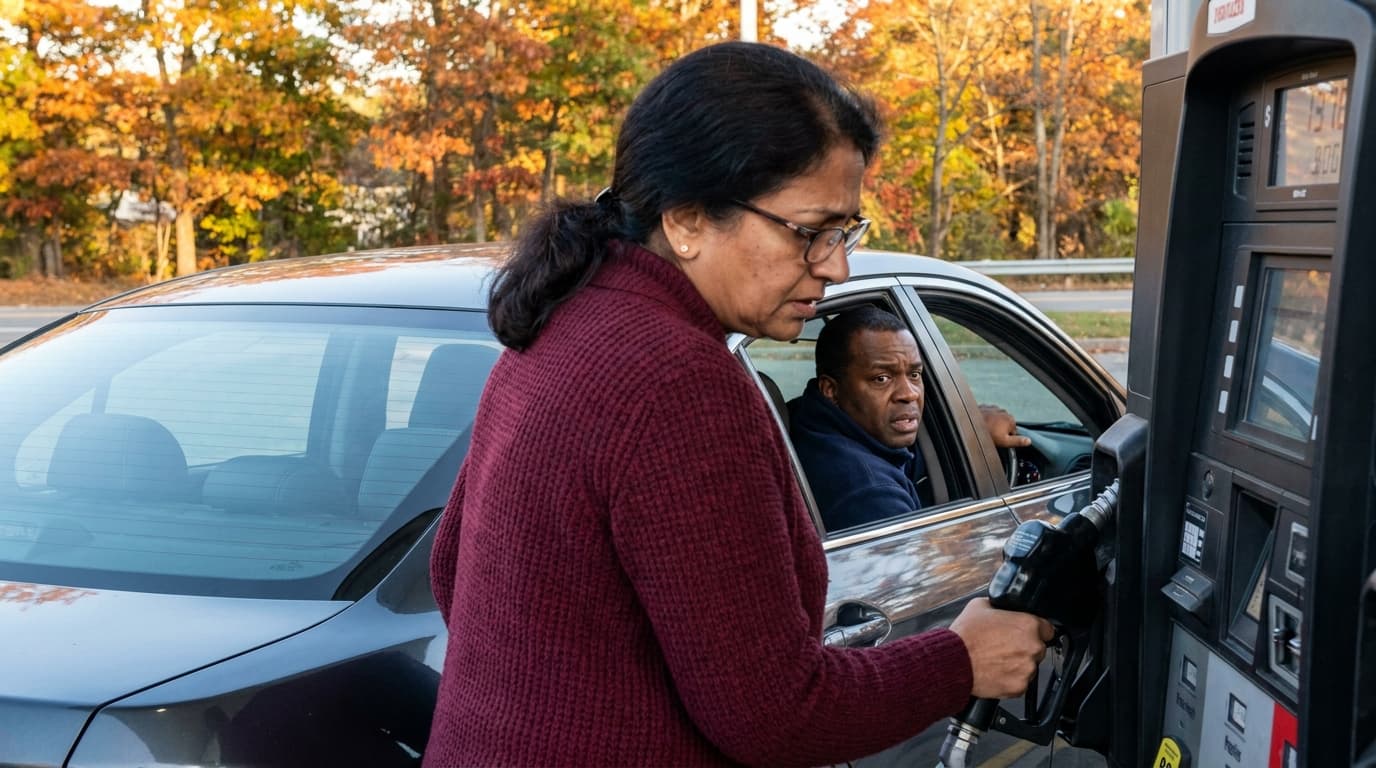
The IMF's latest push for fiscal oversight of major economies, backed by China's central bank governor at a recent international forum, is sending a clear signal: global debt imbalances are serious enough to warrant coordinated scrutiny. For American households already carrying credit card balances at an average annual rate of 21.19% (Federal Reserve, August 2026), that kind of macro-level pressure rarely stays abstract for long. It filters down through energy markets, supply chains, and consumer costs, and right now, one of the most immediate places you feel it is at the gas pump. With regular unleaded averaging $4.33 a gallon (U.S. Energy Information Administration, week of October 12, 2026), the squeeze on household budgets is entirely real, and it's arriving alongside elevated borrowing costs that show no sign of retreating quickly.
Quick Answer
How are rising gas prices affecting households carrying credit card debt?
With gas prices at $4.33 a gallon (EIA, October 2026) and credit card APRs averaging 21.19% (Federal Reserve, August 2026), families face a dual squeeze: higher fuel costs leaving less room in the budget, while revolving debt compounds at a punishing rate. A personal loan at a lower fixed rate may ease the pressure. Read on for details.
What the IMF Fiscal Warning Actually Means for Your Wallet
China's endorsement of IMF oversight of advanced-economy fiscal risks, reported by The Times of India, reflects a growing international consensus: debt levels and financial imbalances in major economies are becoming a systemic concern. When central banks and international institutions highlight cross-border capital flow risks, the downstream effect often includes currency volatility and commodity price swings, and crude oil is among the most sensitive commodities to that kind of uncertainty.
That matters directly to what you pay for gas. Diesel is already at $6.18 a gallon nationally (EIA, October 2026), and diesel prices shape the cost of virtually every product that moves by truck. Higher transport costs feed into grocery bills, utility costs, and the general inflation picture captured by a Consumer Price Index reading of 336.940 (Bureau of Labor Statistics, September 2026). For households in Illinois and across the Chicago metro area, where the cost of living in Chicago already strains median budgets, this combination of fuel costs and sticky inflation creates a compounding pressure that's hard to outrun on a fixed income.
Where U.S. Households Stand Right Now
The national median household income sits at $74,580 (U.S. Census Bureau, 2023). Against that benchmark, consider that total U.S. consumer revolving debt has reached $1.35 trillion (Federal Reserve, August 2026). That's not a rounding error; it reflects millions of families using credit cards to bridge the gap between income and rising costs, including gas.
At 21.19%, the average credit card APR is not a rate that forgives passivity. Every month you carry a balance, a meaningful portion of your payment goes nowhere near the principal. Readers exploring financing options with less-than-perfect credit histories can find a focused breakdown of what's available through resources like bad credit loans illinois, which covers the realistic landscape for Illinois borrowers specifically.
What Credit Card Debt Is Actually Costing You
Say you're carrying $10,000 on a credit card at 21.19% APR. Making only the minimum payment, the monthly interest charge alone runs roughly $177. Over one year, that's more than $2,100 in interest on a balance that may be moving very slowly downward. Stretch that out over five years, and the total interest paid can approach $6,000 or more, depending on how consistently you pay above the minimum.
Now compare that to a 24-month personal loan at the Federal Reserve's current average rate of 11.9%. On a $10,000 balance, the fixed monthly payment comes to approximately $470, with total interest paid over the life of the loan around $1,280. That's a difference of roughly $895 compared to what you'd pay in interest alone over the same period on the credit card, and you'd own your debt completely in 24 months rather than watching it persist indefinitely.
Scale that up. On a $20,000 balance, the interest savings from consolidating at 11.9% versus carrying at 21.19% over 24 months can reach approximately $1,790. On $30,000, the gap widens to roughly $2,685. Use a personal loan calculator to run your own numbers with your actual balance and timeline.
Personal Loan Payment Calculator
Estimate your monthly payment on a fixed-rate personal loan.
Monthly Payment
$470.27
Total Interest
$1,286
Total Cost
$11,286
A 9.29 percentage-point gap between average personal loan rates and average credit card APRs isn't a footnote; it's the difference between a debt that shrinks on a schedule and one that quietly compounds while you're busy paying for gas.
How Families Are Getting Ahead of Rising Costs
The strategic move, for households carrying high-rate revolving debt, is to consolidate before rising fuel and living costs erode your monthly cushion further. A fixed-rate personal loan converts an unpredictable, open-ended liability into a defined monthly obligation, which makes budgeting around volatile gas prices considerably more manageable.
If you've been hesitant because your credit profile isn't pristine, that's a common concern right now. Unemployment stands at 4.2% (Bureau of Labor Statistics, September 2026), and many households have navigated late payments or reduced income over the past few years. Safe Bet Loans works with personal loan lenders who specialize in a range of financial situations, including those that traditional banks often decline. Exploring what's available costs nothing and gives you real information to work with.
Steps to Take Before the Pressure Gets Worse
- Calculate your true carrying cost. Add up every credit card balance you hold and multiply the total by your average APR. That annual interest figure, often surprisingly large, is your baseline. It's what you're paying simply to stay in place.
- Map your fuel and fixed expenses against your take-home pay. With gas at $4.33 a gallon, a 15,000-mile annual driving pattern costs roughly $1,300 to $1,500 in fuel alone, depending on your vehicle's efficiency. Knowing exactly where your money goes each month is the prerequisite for any consolidation decision.
- Compare personal loan options before your budget tightens further. The Federal Reserve's average 24-month personal loan rate of 11.9% represents a meaningful reduction from average credit card APRs. Visit Safe Bet Loans to see what options may be available for your specific situation, without obligation.
The IMF's fiscal warning and China's backing of that scrutiny reflect global anxieties that aren't resolved overnight. What you can resolve, on your own timeline, is the portion of your financial picture that's within reach. High-rate revolving debt carried into a period of elevated gas prices and persistent inflation is a compounding disadvantage. Addressing it now, while rates on personal loans remain below the credit card average, is precisely the kind of forward-looking decision that separates households that gain ground from those that tread water. Check your options through Safe Bet Loans and see what's possible.
Frequently Asked Questions
How do gas prices affect household debt levels?
When gas prices rise, more of a household's monthly budget goes toward fuel, leaving less available for debt repayment. With regular gasoline at $4.33 a gallon (EIA, October 2026), families who drive regularly may lean more heavily on credit cards to cover other expenses, accelerating revolving debt accumulation at rates that currently average 21.19% (Federal Reserve, August 2026).
What is the current average credit card APR in the U.S.?
The Federal Reserve reported an average credit card APR of 21.19% as of August 2026. That figure applies to accounts carrying a balance. It means interest compounds quickly on any unpaid amount, making high balances expensive to hold even when you're making regular minimum payments each month.
Who qualifies for a personal loan to consolidate credit card debt?
Qualification criteria vary by lender, but most evaluate credit score, income stability, and existing debt load. Borrowers with imperfect credit histories still have options. Lenders accessed through platforms like Safe Bet Loans work with a range of financial profiles, including situations that traditional banks may decline, making it worth checking even if your credit isn't perfect.
What are the pros and cons of consolidating debt with a personal loan?
The primary advantage is a lower, fixed interest rate. The Federal Reserve's current average 24-month personal loan rate is 11.9%, compared to 21.19% for credit cards. The main risk is extending repayment if you take a longer term. Discipline matters: consolidation works best when you don't accumulate new card balances after consolidating.
How much could I save by switching from a credit card to a personal loan?
On a $10,000 balance, moving from 21.19% credit card APR to an 11.9% personal loan over 24 months can save roughly $895 in interest. On $20,000, estimated savings approach $1,790. Actual results depend on your specific rate, term, and payment consistency. A personal loan calculator can run your exact scenario in minutes.